By Mohamed Eid
The chair was too small for Samatar’s body.
It sat between his father’s hospital bed and the doctor’s rolling computer, a gray plastic chair with metal legs and a crack along the back. Samatar had seen chairs like it all his life: at school offices, county buildings, immigration appointments, clinics, and the small rooms where families waited for someone official to explain what would happen next.
This chair was different because everyone in the room expected him to become the bridge.
His father, Xasan, sat on the bed with his shoes still on. He did not trust hospitals enough to remove them. A white blanket covered his knees. His hands rested on top of it, strong hands, warehouse hands, hands that had fixed broken cabinets, carried bags of rice, flour, and sugar, lifted sleeping children from couches, and signed forms he could not fully read.
The doctor smiled at Samatar, then at his father.
“Can you ask him when the pain started?”
Samatar translated into Somali.
His father answered without looking at the doctor. “Three months.”
Samatar hesitated.
“Three months,” he said in English.
The doctor typed. “Has it gotten worse?”
Xasan gave a small shrug. “It comes and goes.”
Samatar translated.
His father glanced at him sharply. “Do not make it sound serious.”
Samatar did not translate that part.
At twenty-two, Samatar was used to this work. He had been interpreting since he was nine, when his mother handed him the electric bill and said, “Tell me why they want this much.” He had translated school letters, insurance forms, pharmacy instructions, landlord warnings, voicemail messages, and the cold language of government envelopes. English had made him useful before it made him confident.
In college, people praised him for being mature. They did not know maturity had started as paperwork.
The doctor kept asking questions.
Did the pain move?
Did his father feel dizzy?
Was there blood?
Had he lost weight?
With every question, Samatar felt the room tightening. His father answered too casually. He smiled at the wrong moments. He waved away details as if pain were an impolite guest that could be ignored until it left.
Then the doctor said, “We found something on the scan.”
Samatar did not translate immediately.
His father looked at him. “What did she say?”
The doctor’s voice became slower, softer, which somehow made it worse. “There is a mass. We do not know yet what it is. We need more testing.”
Samatar heard the English clearly. Too clearly. The words stood in the air like furniture no one had ordered but everyone had to live around.
“Samatar?” his father said.
He translated the first part: “They saw something on the scan.”
His father’s face did not change. “Something?”
“A kind of swelling,” Samatar said.
The doctor watched him. She knew enough to know he had changed it.
“Mass,” she said gently. “It is important that he understands.”
Samatar nodded, angry at her for being right.
He tried again. “They found a mass. They do not know what it is yet. They need more tests.”
His father looked down at his hands.
For the first time that morning, the room became honest.
Xasan had survived three countries before America. He had left Somalia when war made ordinary days dangerous. He had worked in Kenya, lived in a crowded apartment in Nairobi, and arrived in Columbus with one suitcase, a thin jacket, and two children who learned English too quickly. He respected doctors, but he did not trust systems. Systems had always asked for his name, his number, his proof, his patience, and then returned with another form.
“Ask her if I can go to work tomorrow,” Xasan said.
Samatar closed his eyes.
“Dad.”
“Ask.”
The doctor answered before Samatar translated. Maybe she understood the shape of the question. “I would prefer he rests until we know more.”
Samatar translated.
His father shook his head. “Rest does not pay rent.”
Samatar translated that too.
The doctor stopped typing. “I understand. But this needs attention.”
Outside the room, a machine beeped. A nurse laughed somewhere down the hall. Life continued with no respect for private disaster.
Samatar’s phone buzzed. His sister, Hodan.
What did they say?
He stared at the message and did not answer.
His father saw the name on the screen. “Do not tell your mother yet.”
“She has to know.”
“Not until we know.”
“She is your wife.”
“And she will worry herself sick before there is anything to worry about.”
Samatar wanted to say there was already something to worry about. Instead he looked at the floor. The interpreter’s chair creaked under him.
The doctor handed them papers: follow-up appointments, lab work, instructions, phone numbers. Samatar placed them in a folder, the way he had done since childhood. His father thanked the doctor in English, using the careful voice he saved for authority. “Thank you, doctor. God bless.”
In the parking lot, the July heat rose from the asphalt. Xasan walked slowly but refused help. Samatar unlocked the car.
“You translated too much,” his father said.
Samatar laughed once. “That is the point.”
“No. Some things are for later.”
“Later is how we got here.”
His father stopped beside the car. For a moment Samatar saw not the stubborn man who hid pain, but the tired one underneath. The one who had carried fear across borders and called it responsibility.
“You think I hide because I am foolish?” Xasan asked.
Samatar said nothing.
“I hide because everyone is already carrying something.”
They drove home without music.
At the apartment, Samatar’s mother was making shaah with ginger. She looked from husband to son and knew, as mothers often do, that the room had changed before anyone spoke.
“What did they say?” she asked.
Xasan removed his shoes slowly.
Samatar waited for his father to answer. He wanted him to choose truth without being forced.
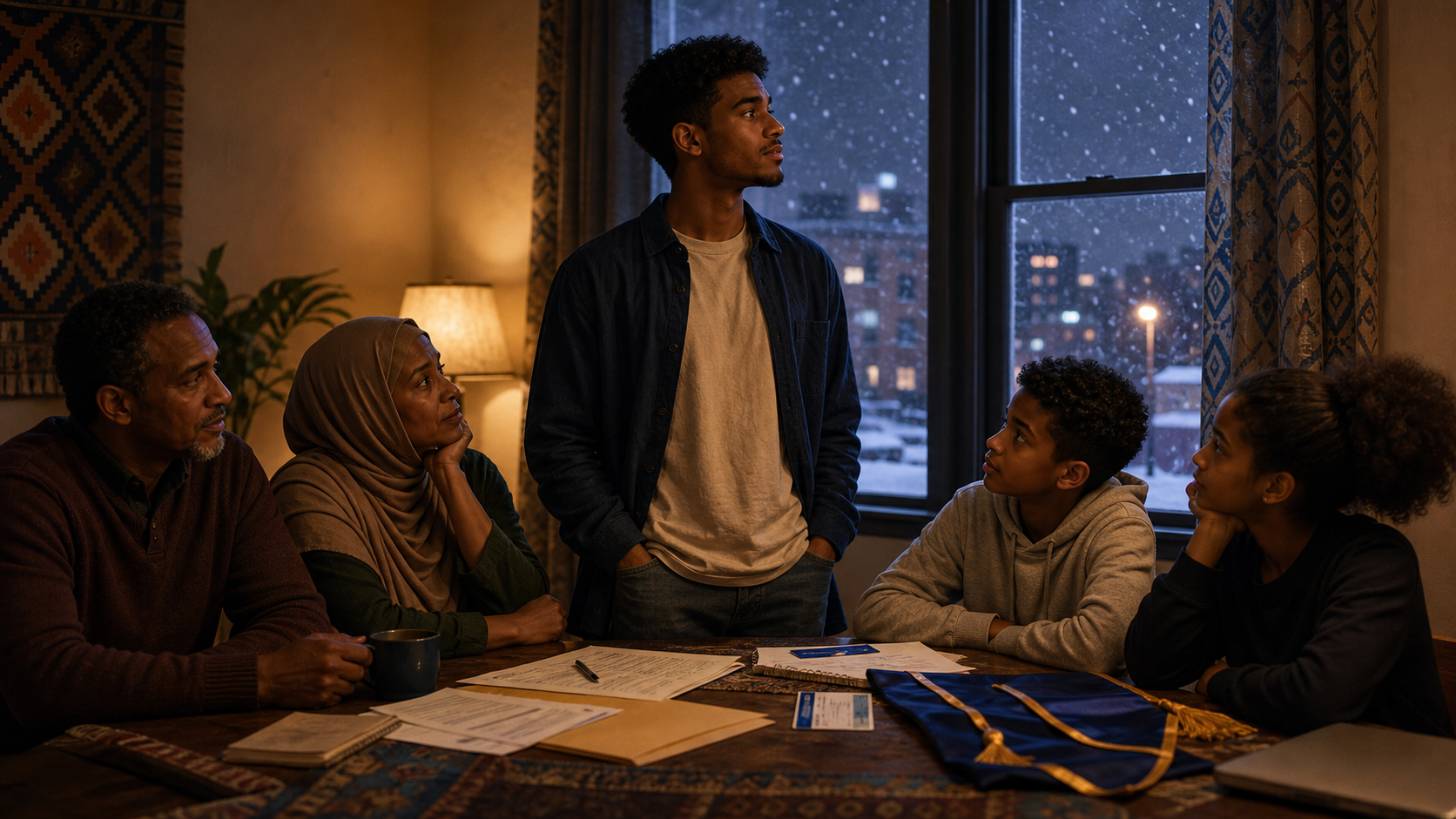
His father sat at the kitchen table. The same table where Samatar had translated bills, permission slips, tax letters, and doctor’s instructions for half his life. The same table where English entered the house carrying problems.
Xasan looked at his wife. “They found something. We do not know yet.”
Her hand went to her chest.
Samatar translated the medical details carefully, not because his mother did not understand, but because the family needed the words to be exact. Mass. More tests. Follow-up. Rest. Call if pain worsens.
No one spoke for a while.
Then Hodan came from her room and asked, “Is Aabbo okay?”
Samatar almost said yes. The old habit rose in him automatically: protect the younger one, soften the sharp edge, keep the family moving.
His father looked at him.
For once, Samatar did not sit in the interpreter’s chair alone.
“We are finding out,” Samatar said.
It was not comfort, but it was truth.
That evening, the family ate quietly. His mother called an aunt from the masjid. Hodan washed dishes without being asked. Xasan sat near the window, prayer beads moving through his fingers.
Samatar gathered the hospital papers into a folder and wrote the appointment date on the front in large letters. He had always thought translation meant carrying words from one language to another. That day he understood it was also carrying fear without letting it become a lie.
Before bed, his father knocked on his door.
“You did well today,” Xasan said.
Samatar looked up from his laptop.
“I was angry.”
“Still, you did well.”
His father stood awkwardly, half inside the room, half in the hallway.
“When you were small,” Xasan said, “I hated needing you for English. I wanted to be the father. Not the child.”
Samatar closed the laptop.
“You were still the father.”
“Sometimes.”
“Always.”
Xasan nodded as if accepting a difficult translation.
After he left, Samatar sat in the quiet. The house smelled of ginger, onions, and hospital paper. Tomorrow there would be phone calls, appointments, insurance questions, and more words nobody wanted to say. But they would say them.
The interpreter’s chair had followed Samatar home, invisible but familiar.
This time, he would not sit in it alone.
Author note
This story is part of Afka Suugaanta’s East African diaspora story series, focused on immigration, family, language, memory, dignity, and the bridge between back home and the United States.
Excerpt
Samatar has interpreted English for his Somali father since childhood. When a hospital scan finds something serious, he must decide whether translation means protecting his family from fear or telling the truth clearly enough to face it together.
Reader question
Have you ever had to translate something serious for a parent or elder before you felt ready?