By Mohamed Eid
Ayaanle first saw the headline on his mother’s phone.
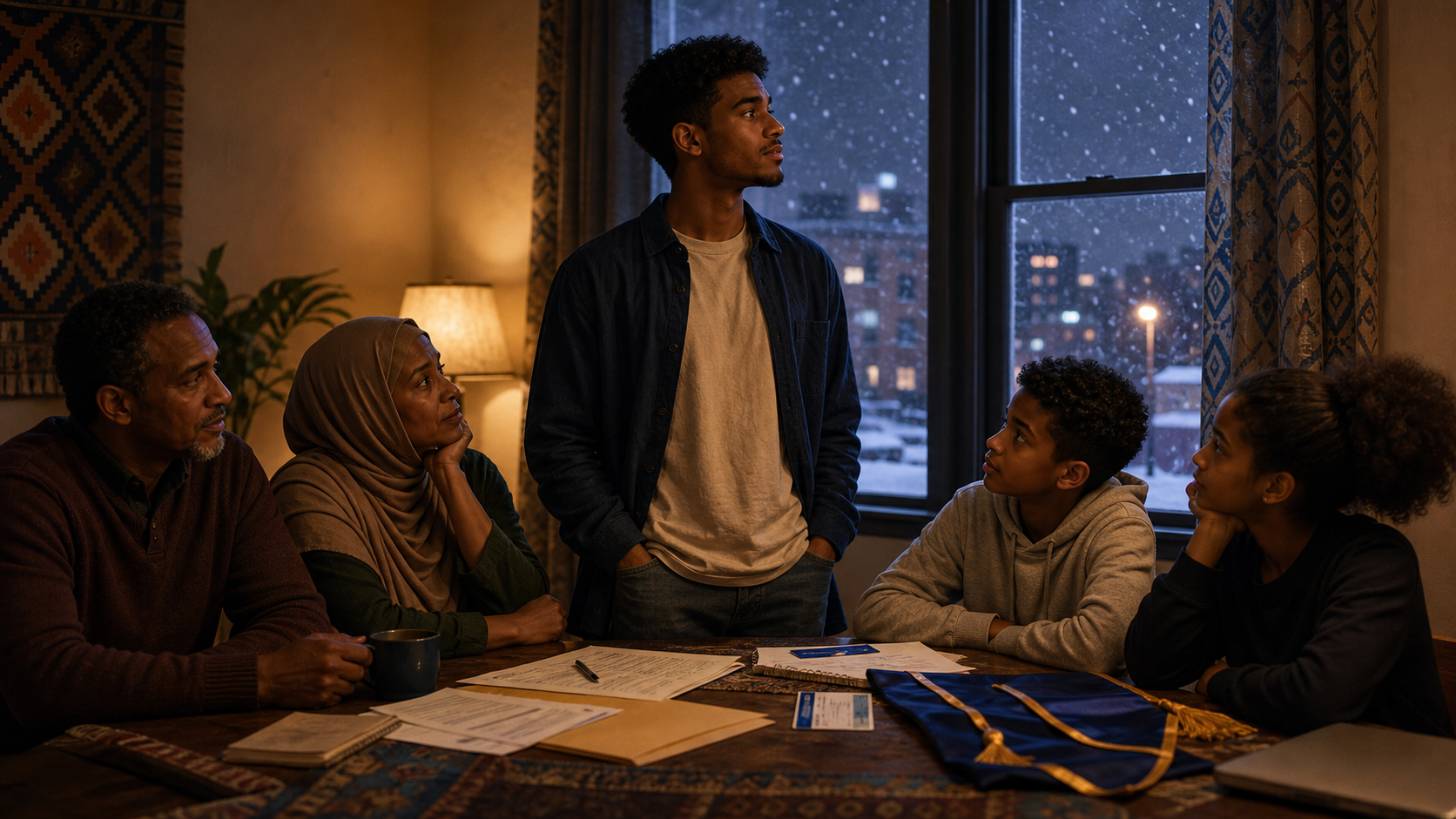
She was standing in the kitchen with one hand inside a bowl of flour, mixing canjeero batter, while the other hand held the phone too close to her face. The blue light made her eyes look tired before the day had even begun.
“Hooyo, why are you reading comments?” Ayaanle asked.
His mother did not answer. Her lips moved silently over English words she did not want to pronounce.
On the screen was another story about Somali boys, gangs, shootings, meetings, police, community leaders, and fear. The kind of story that made everyone in Minnesota suddenly speak as if they knew every Somali mother’s kitchen, every young man’s heart, every hallway where boys leaned against walls pretending they were not lonely.
Ayaanle reached for the phone gently.
“Hooyo, iska daa. Don’t read those.”
She pulled it back. “Haddii ay annaga naga hadlayaan, sideen isaga dhaafaa?”
He had no answer.
Outside their apartment in Minneapolis, the morning buses hissed near the curb. A man pushed a shopping cart through the alley. Somewhere below, someone’s car alarm complained for three seconds and gave up. It was summer, but the building still held the smell of old winter: wet carpet, radiator dust, shoes, cooking oil, and all the lives stacked above one another.
Ayaanle was nineteen. He did not drink. He did not smoke. He did not carry anything heavier than his work backpack, where he kept a phone charger, a cracked notebook, a prayer rug folded into a plastic bag, and his community college ID. He worked afternoons at a phone repair shop near Lake Street and coached younger boys at the gym on Fridays when the older volunteer could not come.
Still, when certain headlines appeared, he felt accused before anyone said his name.
At school he was too Somali for some people, too quiet for others, too Muslim for the careless jokes, too Black when the room got tense, and somehow not Somali enough when cousins from back home laughed at his careful Af-Soomaali.
In America, people asked where he was really from.
Back home, cousins asked why his Somali sounded like it had crossed an ocean and lost weight.
Only his mother asked if he had eaten.
“Waan fiicanahay, Hooyo,” he said, though she had not asked yet.
She looked at him. “Qof kasta oo ‘waan fiicanahay’ yiraahdaa ma fiicna.”
He smiled a little. “You are starting early today.”
“I am your mother. I started before you were born.”
She returned to the bowl, but her eyes stayed troubled. “Last night your auntie called from Nairobi. She saw the news. She asked if Minnesota is safe.”
“What did you say?”
“I said Minnesota is like everywhere. It has good people and lost people.”
“That is true.”
“It is not enough.”
Ayaanle knew what she meant. Truth did not always protect a community. Sometimes truth arrived late, after strangers had already chosen a simpler story.
That afternoon, on his way to work, Ayaanle saw Sakariye outside the corner store.
Sakariye was sixteen, thin, restless, and always dressed as if someone might take his picture. He was not Ayaanle’s brother, but in Somali families the difference between cousin, brother, neighbor, and responsibility was not always clear. Sakariye’s mother cleaned offices at night. His father drove trucks between Minnesota and Ohio. His older brother had been arrested two winters ago, and since then Sakariye had learned to laugh in a way that made adults stop asking questions.
He stood beside two older boys Ayaanle did not know well enough to greet with comfort. One wore a black ski mask rolled above his forehead though the day was hot. The other kept tapping a small bottle against his palm.
“Ayaanle!” Sakariye called. “You too busy now?”
Ayaanle stopped.
“Busy enough,” he said.
The older boy with the bottle looked him up and down. “College boy.”
Ayaanle did not answer him. He looked at Sakariye. “Your mother asked me yesterday if I saw you.”
Sakariye’s smile weakened. “Why she asking everybody?”
“Because she is your mother.”
“Tell her I’m alive.”
“Being alive is not the same as being okay.”
The older boys laughed, but Sakariye did not. For one second his face became young again, almost embarrassed. Then he shrugged.
“You sound like a sheekh.”
“No,” Ayaanle said. “A sheekh would be more patient.”
The boy with the bottle stepped closer. “You got a problem?”
Ayaanle felt his heartbeat change. Not fear exactly. Calculation. The quick math of being a young Black Muslim man in a city where one wrong movement could become a story someone else told badly.
He lifted both hands slightly, palms open.
“No problem. I’m taking my cousin with me.”
Sakariye frowned. “I didn’t say I’m coming.”
Ayaanle looked at him. “Your mother made sambuus. If you don’t come, I will eat yours.”
For a moment nobody moved. Then Sakariye cursed under his breath and stepped away from the wall.
“You’re annoying.”
“Alxamdulillah,” Ayaanle said. “It works.”
They walked two blocks in silence.
At the bus stop, Sakariye kicked a pebble into the gutter. “You think you’re better than people.”
“No.”
“You do.”
“I think some corners are hungry,” Ayaanle said. “If you stand there long enough, they eat your name first.”
Sakariye looked away.
Across the street, a woman bent down to pick something sharp from the grass with a napkin. She moved carefully, like the ground itself had betrayed her. Ayaanle had seen more of that lately: needles near bus shelters, people folded over in doorways, the kind of suffering adults discussed in meetings while children learned to step around it.
“Back home they think we have everything,” Sakariye said.
“Who told you that?”
“My cousins. They say, ‘You are in America. Why are you stressed?’”
Ayaanle almost laughed. “My cousin in Hargeisa told me I should send him an iPhone. I told him I repair phones I cannot afford.”
Sakariye smiled despite himself.
Then his face closed again. “Here they think we are all dangerous.”
“Some people do.”
“And back home they think we are soft.”
“Some people do.”
“So where are we supposed to stand?”
The bus came before Ayaanle could answer.
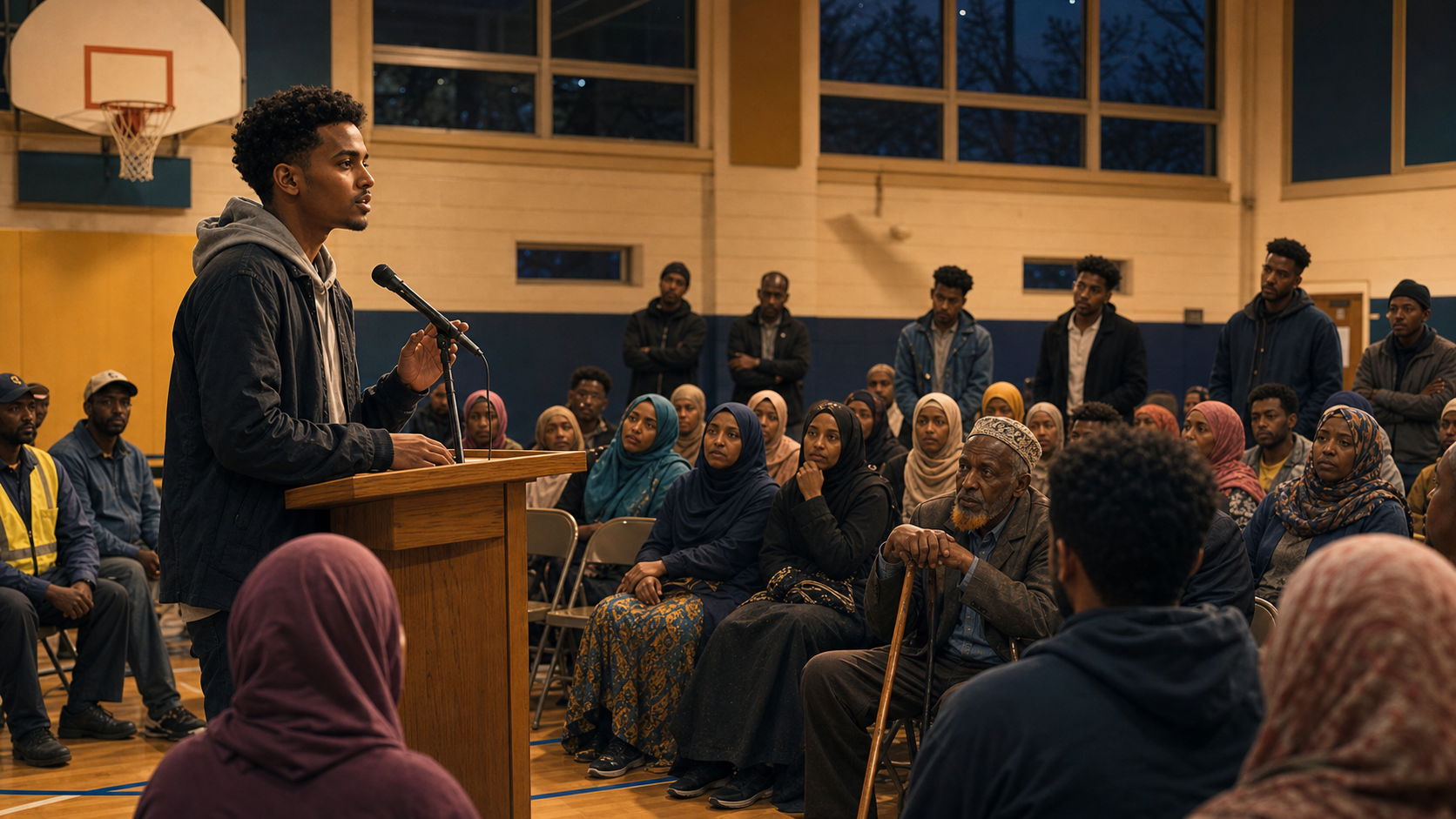
That evening, the community meeting was held in a school cafeteria that smelled like floor wax and old pizza. Parents filled the chairs. Mothers in hijabs whispered beside fathers wearing work uniforms. A few young men stood along the wall, pretending they had not come to listen. Community leaders spoke. Police spoke. Some people demanded safety. Others demanded respect. Many demanded both.
Ayaanle sat near the back with Sakariye beside him.
An elder stood up with a cane in his hand. His voice shook at first, then steadied.
“Ceeb ma aha in dhibaatada laga hadlo,” he said. “Ceebtu waa in carruurteenna laga hadlo, iyadoo aan iyaga lala hadlin.”
The room became quiet.
A mother stood next. “My son is not a headline,” she said in English. “He is a boy who needs men to show up before the street does.”
Ayaanle felt Sakariye shift beside him.
After the meeting, while adults formed circles of argument and prayer, Ayaanle found himself near the microphone. He had not planned to speak. His hands were sweating. His mother, sitting three rows from the front, looked back and saw him.
She did not smile. She nodded once.
Go on.
Ayaanle took the microphone.
“My name is Ayaanle,” he said. “I was born here. My parents were not. I have been told to be grateful so many times that sometimes gratitude feels like a door I am not allowed to leave.”
A few people murmured.
“I am grateful,” he continued. “But I am also tired. Tired of seeing boys disappear into corners. Tired of aunties crying quietly. Tired of people acting like the only choices are to deny the problem or shame the whole community.”
He looked at Sakariye, then at the elders.
“We need more than warnings. We need places to go after school. We need mentors who know our names before police know our faces. We need jobs that teach us something. We need fathers and uncles and older brothers to stop saying young people are lost while never asking where they are trying to go.”
His voice almost broke. He swallowed.
“And we need young men like me to stop thinking being clean means staying far away. Sometimes keeping your hands clean means reaching back.”
He paused.
Then he looked down at the folded paper in his hand. He had written the words the night before, not as a poem for applause, but as something he could finally say without hiding behind politeness.
“They say the West changed us,
but the blocks still raise us.Single mothers praying tahajjud
while sons chase status.Every week another stabbing,
another hashtag, another janazah.Young boys wearing pain like fashion,
laughing through trauma.A conflicted personality—
tweeting about unity,
then tearing down their own community.Speaking politics with intensity,
but ignoring accountability.Everybody blames the system,
nobody checks the mirror.Brothers talk revolution online
but make their own homes colder, bitter.Culture became ego.
Advice became disrespect.The elders say, ‘Dhagayso, waryaa!’
The youth say, ‘Nah, ma fahmaysaan!’Girls are overburdened,
boys emotionally absent.Nobody healed from the war,
they just passed down the damage.And the diaspora keeps spinning—
London to Minnesota,
Stockholm to Toronto.Different accents and languages,
same problems,
same funerals, same sorrow.Young men addicted to image,
to clout, to quick validation.Confusing masculinity with intimidation.
Confusing religion with presentation.And still the mothers stay patient.
Working, sacrificing, waiting.Watching sons become strangers
while silently breaking.Environmental change,
but the behaviours remain.New country, same pain.
New language, same rage.Everybody talking healing,
but nobody really changing.Just surviving, disguising,
internalizing, then exploding.A whole generation lost between cultures,
searching for identity while slowly folding,drifting, resisting, conflicting, existing,
fighting, dividing, colliding,then smiling like everything’s thriving,
while inside they’re sinking, shrinking,thinking:
‘Caado la gooyo, cadho Alle ayay leedahay.’”
The cafeteria stayed silent.
Ayaanle folded the paper again.
“I am not saying this to shame us,” he said. “I am saying it because I still believe we can be honest without giving up on each other. If the boys are hurting, we cannot only fear them. If the mothers are breaking, we cannot only praise them. If the youth are angry, we cannot only silence them. We have to build something before the street builds it for us.”
The room held him carefully.
When he sat down, Sakariye stared at the floor.
Outside, the sky over Minneapolis turned the color of bruised peach. Parents walked to cars. Youth clustered near the sidewalk. Someone laughed too loudly. Someone else wiped tears quickly before friends could see.
Ayaanle’s mother met him near the door.
“Waad qalbi hadashay,” she said.
“I was nervous.”
“Geesinimadu cabsi la’aan ma aha,” ayay tiri. “Geesinimadu waa inaad hadasho adigoo cabsanaya.”
Courage is not the absence of fear. Courage is speaking while afraid.
Sakariye approached slowly. “The gym is open Friday?”
Ayaanle looked at him. “Yes.”
“What time?”
“Seven.”
“Can I bring people?”
Ayaanle studied his face. “Which people?”
Sakariye rolled his eyes. “Normal people.”
“There are no normal people.”
“For basketball, Ayaanle.”
“Yes,” Ayaanle said. “Bring them.”
On Friday, seven boys came. Then eleven. Then fourteen. The gym smelled like sweat, dust, and possibility. Some came to play. Some came because there was nowhere else to be. Some cursed too much. Some asked for water. One asked Ayaanle if community college was hard. Another asked if phone repair made money. Sakariye showed up late, pretending he had not rushed.
At the end, Ayaanle gathered them at half court.
“No speeches,” one boy groaned.
“Good,” Ayaanle said. “Then listen fast.”
They laughed.
He pointed to the door. “Out there, people will call you many things before they know you. Do not help them by losing yourself.”
The boys grew quiet.
“You are not perfect. Neither am I. But you are not garbage. You are not a headline. You are not born for prison, addiction, or somebody’s funeral slideshow. Illaahay kuuma abuurin inaad magacaaga disho. Your families gave you names. Carry them like they matter.”
No one clapped. Boys did not clap for that kind of thing.
But when they left, Sakariye stayed behind to stack chairs.
Ayaanle noticed and said nothing.
Later, walking home, he checked his phone. His cousin from Hargeisa had sent another message: Minnesota ma nabad baa? Is Minnesota peaceful?
Ayaanle looked at the streetlights, the bus shelter, the boys laughing outside the gym, his mother’s apartment window glowing above the block.
He typed back slowly.
Nabaddu diyaar ma aha. Laakiin waan dhisaynaa.
Peace is not ready-made. But we are building it.
Reader Question
What does real support for Somali youth in Minnesota look like before crisis happens?