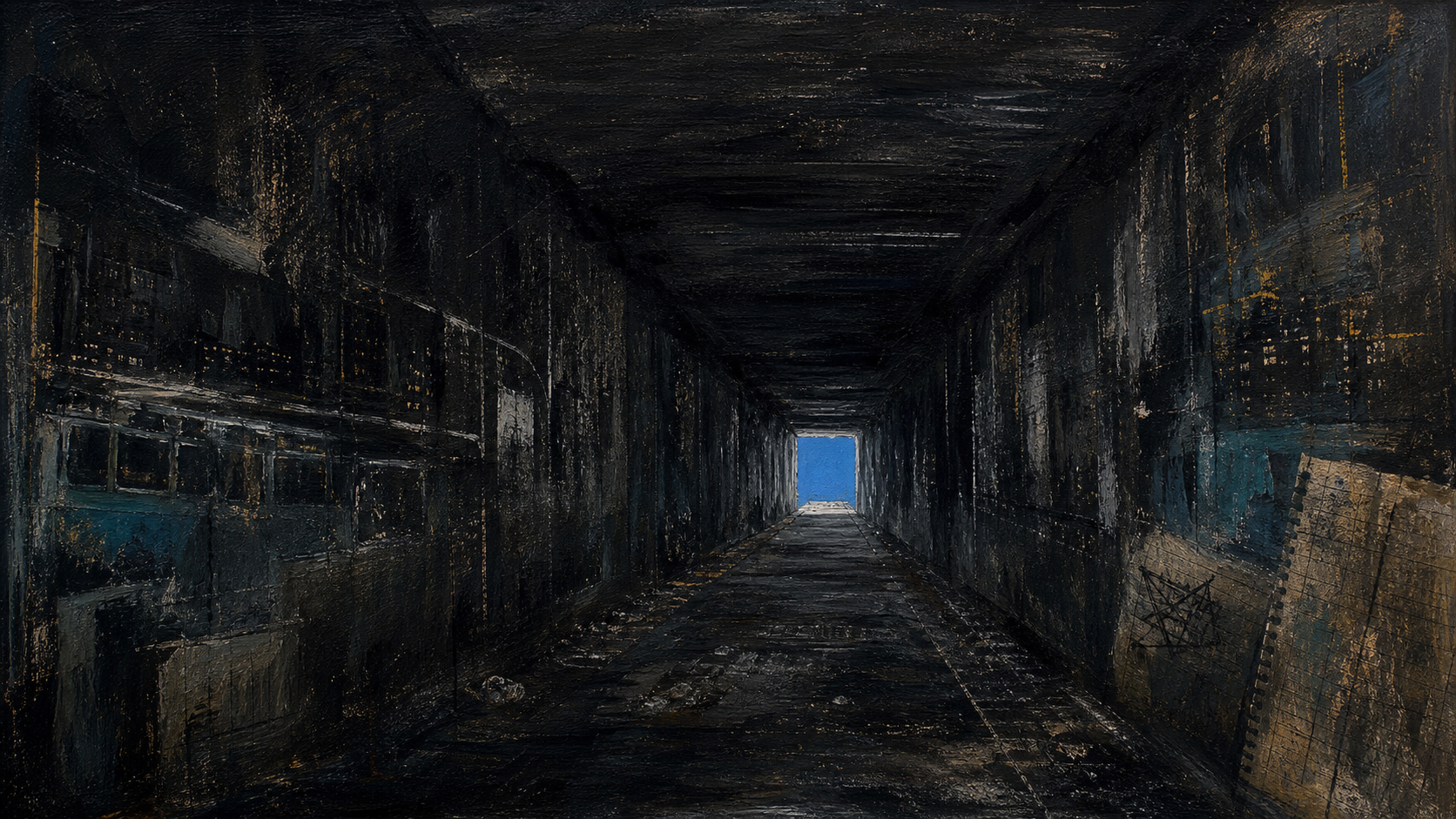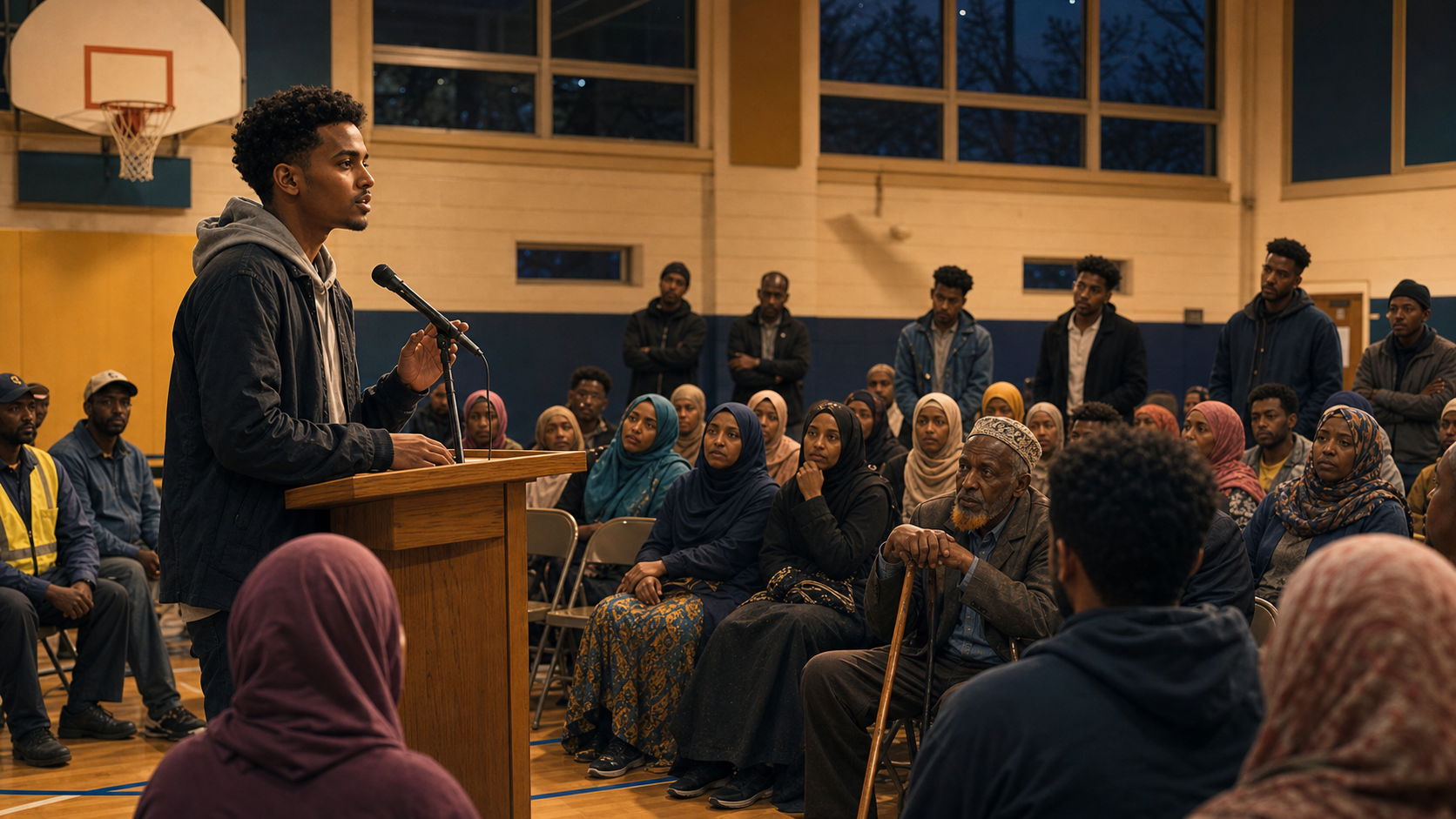
Hamza learns that immigration does not move one family at the same speed. Between parents carrying memory and siblings growing into America, he becomes the bridge nobody remembers to ask about.
When Hamza first arrived in Minnesota, he thought snow was silence made visible.
It fell without argument, covering the sidewalks, the cars, the roofs of apartment buildings, even the small mistakes people left outside: a lost glove, a crushed soda can, a bicycle chained to a fence. Back home, rain announced itself. It knocked on tin roofs. It woke goats and children. It filled the road with red mud and made people shout across courtyards. Snow did not shout. It erased.
His mother, Xaawo, stood by the window that first morning and watched the white sky press itself against the glass.
"Subxaanallaah," she whispered. "Dunida Ilaahay waa yaab."
His father, Cabdi, did not come to the window. He sat on the edge of a donated couch, holding a folder of resettlement papers like it was a verdict.
Hamza was seventeen then, old enough to remember home and young enough to be remade by elsewhere. His little sister, Ifraax, was eight. His brother, Saalax, was six. They learned quickly. Too quickly, their mother sometimes said. Within months they were correcting her at grocery stores.
"No, hooyo, don’t say it like that."
"Hooyo, that’s not how the machine works."
"Hooyo, just give me the card."
Hamza watched his mother’s hand freeze in the air, debit card between two worlds. He saw how embarrassment could shrink a parent without anyone touching them.
That was when he understood, although he could not have explained it yet, that immigration did not move one family together. It moved each person at a different speed.
His parents moved with memory tied around their ankles. His siblings moved with the lightness of children who did not know what had been left behind. Hamza moved between them, carrying translation in both directions.
At school, he became "Ham-za," the pause in the teacher’s mouth turning his name into a small foreign object. At home, he became "waryaa," "adeer," "wiilkayga," depending on who needed him.
"Tell your father the appointment is Thursday."
"Tell your teacher I was sick."
"Tell your sister she cannot wear that."
"Tell hooyo that everybody wears this."
By the end of his first year, Hamza had learned that a bridge is praised only when people are crossing. Nobody asks whether the bridge is tired.
His father had been respected once. This was not something Cabdi said often, but it lived in the way he folded his clothes and corrected people’s posture. Back home, men greeted him with both hands. He had known who he was. In Minnesota, he took a job cleaning offices after midnight. He left the apartment when the children were getting sleepy and returned when the hallway smelled like other families’ breakfasts.
One morning Hamza found him at the kitchen table, still wearing his work shoes, rubbing his thumb over a small crack in the plastic tablecloth.
"Aabbe, why don’t you sleep?"
Cabdi looked up slowly. His eyes were red, but not soft.
"Nin hurdo badan ma dhiso guri," he said. A man who sleeps too much does not build a home.
Hamza nodded, though he wondered what kind of home required a man to disappear into the night.
His mother worked too. At first she cleaned hotel rooms. Later she watched children for women who worked longer shifts than she did. Her back hurt. Her English came in broken pieces, but her understanding was sharp. She noticed every unpaid bill, every strange friend, every silence her children carried into the house.
"Hamza," she said one evening while stirring maraq, "adiga ayaa iga indho dheer meeshaan." You see farther than me in this place.
He wanted to tell her he did not see farther. He only stood closer to the danger.
Because America was not one thing. That was the first lie people told about it.
It was a library card and an eviction notice. It was a teacher who stayed after school to explain college forms, and a security guard who followed him through a store aisle. It was halal restaurants, Somali malls, Friday khutbahs in school cafeterias, and boys outside gas stations trying to become hard before anyone could call them lost.
It was a place where Ifraax could become anything, and also a place that taught her to be ashamed of her mother’s accent before she knew the cost of that shame.
It was a place where Saalax learned basketball, slang, confidence, and distance. By thirteen, he spoke to his father through one-word answers.
"School?"
"Good."
"Prayer?"
"Later."
"Friends?"
"Chill, aabbe."
Cabdi hated that word. Chill. It sounded to him like disrespect wearing a smile.
One night, after Saalax came home late, father and son stood facing each other in the living room. Hamza was twenty-four by then, attending community college during the day and working security at night. He had come home with textbooks in his backpack and exhaustion in his bones.
"You think this country will raise you better than us?" Cabdi asked.
Saalax rolled his eyes. "You don’t even know how things work here."
The sentence landed hard.
Xaawo, standing near the hallway, closed her eyes as if she had been struck.
Hamza stepped between them before his father could answer.
"Saalax," he said quietly, "qofka ku dhalay sidaas looma yiraahdo. Ma fiicna."
His brother’s face tightened. "You always take their side."
Hamza almost laughed. Not because it was funny, but because it was unbearable.
Their side. His side. The old side. The new side.
He wanted to grab Saalax by the shoulders and say: I have been translating your freedom into words they can survive. I have been translating their fear into advice you can hear. I have been standing in the doorway so none of us becomes a stranger.
But he only said, "I’m trying to keep the house from breaking."
Saalax looked away. "Maybe it was already broken."
That night Hamza did not study. He went to his room and opened an old notebook. On the first page, years earlier, he had drawn a crooked line between two boxes. One box said "home." The other said "future." Between them he had written: me.
He stared at it for a long time.
Then he crossed out both boxes.
The next morning, in philosophy class, his professor asked whether identity was something inherited or chosen.
Students raised their hands.
Chosen, one said. You decide who you are.
Inherited, said another. Family, culture, history.
Hamza sat in the back, still tired from work, his security uniform folded in his bag. He thought of his father’s cracked hands. His mother’s careful English. Ifraax applying for college scholarships. Saalax pretending not to listen when elders spoke. He thought of himself, always entering rooms as someone’s explanation.
When the professor called on him, Hamza did not know he was going to speak.
"I think identity is a debt," he said.
The room went quiet.
He cleared his throat. "Not always a bad debt. But something you owe attention to. You inherit names, language, wounds, prayers. Then you choose what you will pay forward and what you will stop passing down."
The professor leaned back. "And what happens if you refuse the debt?"
Hamza thought of snow covering everything.
"Then somebody younger pays it without knowing why."
After class, a girl named Muna walked beside him toward the bus stop. She was Ethiopian Oromo, born in Ohio, raised by a grandmother who still called every American city "qurbaha," exile.
"What you said in there," she told him, "that was heavy."
"I didn’t mean for it to be."
"That’s usually when it’s true."
They waited under the shelter while cars hissed through slush. Muna asked what he wanted to study after community college.
"Maybe social work," he said. "Maybe education. Maybe law. It changes every month."
"Ambitious."
"Confused."
"Sometimes that’s the same thing before it gets organized."
He smiled for the first time that day.
Years passed, but not cleanly. Progress did not arrive like a movie scene. It came in ugly little installments.
A passed class.
A failed exam.
A financial aid warning.
An auntie saying, "Goorma ayaad shaqo fiican helaysaa?"
A younger cousin asking for help with an essay.
His father’s blood pressure rising.
His mother hiding pain in her knees.
Saalax getting suspended, then recovering, then slipping again, then calling Hamza at midnight from a bus stop because he did not want to go with boys who were offering him a ride.
"Can you come?" Saalax asked, voice low.
Hamza was in the middle of a shift. He looked at the security monitors, the empty lobby, the textbook open beside him.
"I’m coming," he said.
In the car, Saalax did not speak for ten minutes.
Then he said, "I don’t know who I’m supposed to be."
Hamza kept his eyes on the road.
"Good," he said.
Saalax looked at him. "How is that good?"
"Because now you can stop pretending."
Snow fell softly through the headlights.
Hamza wanted to give him a perfect answer, the kind older brothers are supposed to carry. But he had learned that guidance was not always a speech. Sometimes it was a ride home without shame. Sometimes it was food waiting on the stove. Sometimes it was saying, "I don’t know either, but I know this road is not the one."
By thirty-two, Hamza had a master’s degree, a job working with immigrant youth, and a habit of sitting in his parked car for five minutes before entering the house. Not because he was unhappy. Because he had spent so many years moving between emergencies that peace felt like a room he needed permission to enter.
At his graduation, Xaawo wore a blue dirac with silver edges. Cabdi wore a suit that was slightly too large, bought from a Somali tailor who insisted he looked "aad iyo aad u sharaf badan." Ifraax had become the family organizer, taking photos, fixing collars, directing everyone with American confidence and Somali impatience. Saalax stood beside Hamza, taller now, quieter, studying HVAC at a technical college.
Before the ceremony, Cabdi pulled Hamza aside.
For a moment, father and son stood beneath the noise of other families celebrating in many languages.
Cabdi held out his hand. Hamza took it.
"Aabbe," his father said, voice rough, "waan ogahay inaad nala kortay adigoo weli ilmo ah."
Hamza looked down.
"I know," Cabdi continued in Somali, "you grew up with us while you were still a child."
Neither of them moved.
Then his father said, "I used to think America took my place in this family."
Hamza swallowed.
"But maybe," Cabdi said, "Illaahay adiga ayuu naga dhigay buundada."
The bridge.
Hamza wanted to reject the word. He had hated it for years. A bridge is stepped on. A bridge belongs to neither side. A bridge cracks quietly.
But then he looked across the room.
His mother laughing with women from three countries. Ifraax explaining the ceremony to an elder. Saalax showing a younger cousin how to adjust his tie. People who had crossed oceans, camps, airports, winters, grief, pride, and bills, all standing under one roof.
Maybe a bridge was not only something people crossed.
Maybe a bridge was proof that two lands had not fully lost each other.
Years later, when Hamza spoke to young people at community centers, he never told them immigration was only opportunity. They would not have believed him anyway.
He told them the truth.
That this country can open doors and still make you knock until your hands hurt.
That parents can love you deeply and still misunderstand the world you are surviving.
That younger siblings may look free while quietly drowning in choices nobody taught them how to carry.
That work can humble you, school can exhaust you, and hope can sometimes feel like a bill due before payday.
But he also told them this:
"Do not confuse being between worlds with being nowhere. Meesha dhexe mararka qaar waa meesha wax laga dhiso. The middle place is sometimes where things are built."
And when they asked how to begin, he gave them no grand formula.
"Start with one class. One application. One honest friend. One elder you can still learn from. One younger person you refuse to abandon. One prayer. One page. One skill. One morning where you get up even though yesterday embarrassed you."
Then he would pause.
"Ambition is not always loud. Sometimes ambition is a tired person choosing not to disappear."
Outside, Minnesota kept its seasons. Snow erased. Rain returned. Children grew into translators, rebels, caretakers, strangers, scholars, workers, artists, parents.
And somewhere between the old country and the new one, Hamza kept walking.
Not because he had found a final home.
Because he had learned that some people are born into houses, and some people become the road that helps a family find one.
Reader question: What does it mean to become the bridge in your own family without losing yourself?