
By Mohamed Eid
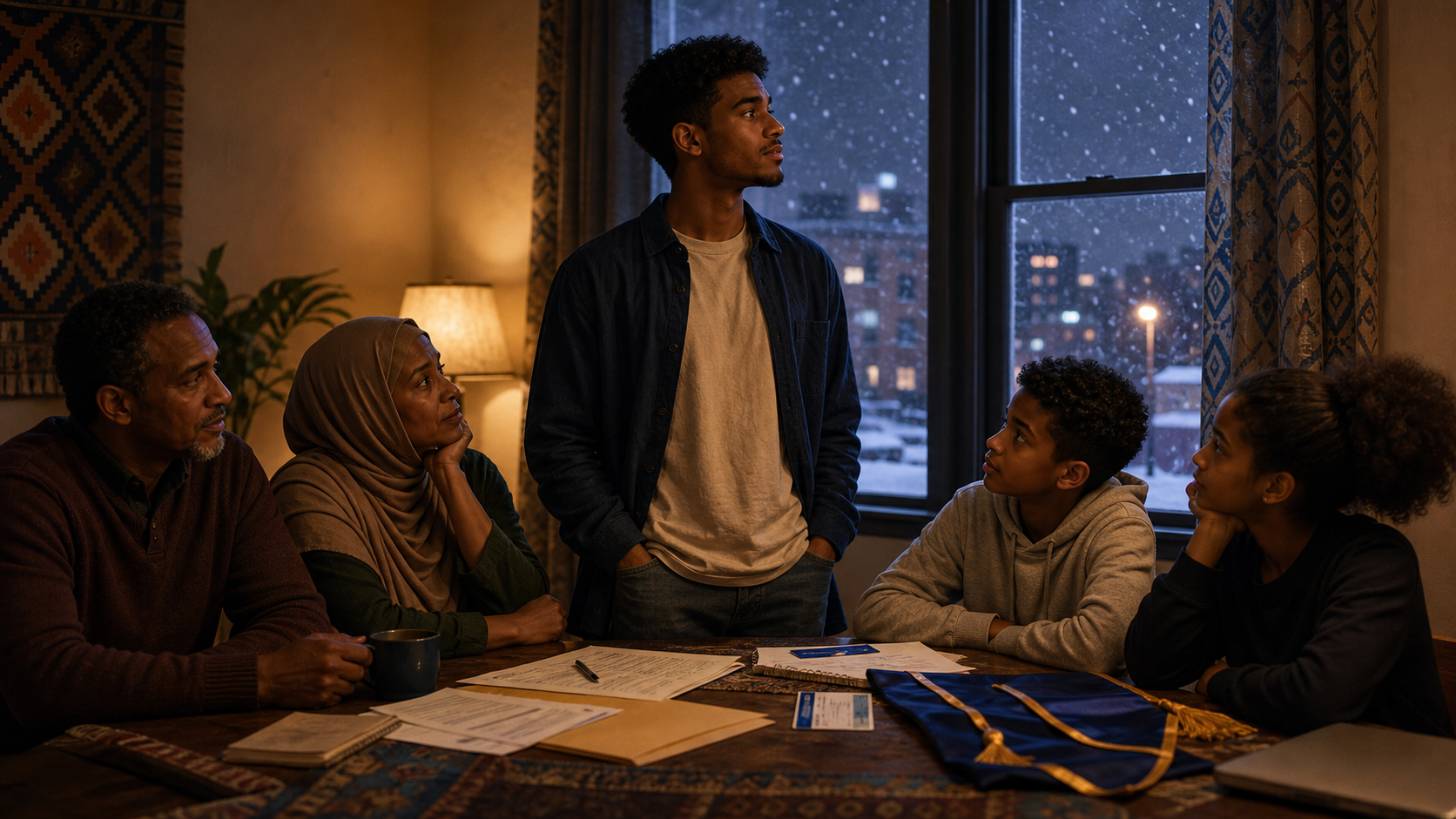
The first snow that fell after Sahra moved to Minneapolis did not impress her.
Her son, Ilyaas, stood by the apartment window with the kind of excitement usually reserved for Eid clothes and airplane announcements. He was sixteen, tall enough to block half the glass, wearing a hoodie with his school name across the chest. Outside, white flakes moved through the orange streetlight, slow and weightless, covering the parked cars, the sidewalk, the bare branches, and the black trash bins behind the building.
“Hooyo, look,” he said. “It is actually coming down.”
Sahra looked up from the onions she was slicing.
“Waan arkaa, hooyo.”
“You are supposed to say it is beautiful.”
“Waa qabow, hooyo,” she said.
Ilyaas laughed. “That is not the same thing.”
She returned to the cutting board. The knife moved through the onion with soft clicks. In the pot, oil warmed beside cumin, garlic, and a cinnamon stick. The apartment smelled like dinner, radiator heat, and the lemon cleaner the landlord used in the hallway. From the window came the quiet sound of snow, which was almost no sound at all.
That was what Sahra disliked most. Snow arrived like a secret. It covered the world without asking anyone to witness it.
Rain in Mogadishu had never been shy.
When the rain came back home, it announced itself first through smell. Dust rose from the road before the first drop touched it. The air changed. Doors opened. Children ran out too early, laughing before the sky had fully decided. Women pulled laundry from lines. Men standing near tea shops looked up as if news had arrived from far away. Then the rain struck metal roofs, plastic buckets, market stalls, bus windows, and the wide leaves of trees that had waited too long.
Rain made the city speak.
Snow made Minneapolis lower its voice.
“Hooyo,” Ilyaas said, still at the window, “when it rains in Mogadishu, is it like the videos?”
Sahra placed the knife down.
Since she arrived seven months earlier, her son had been collecting Somalia in pieces. YouTube walking tours. Old songs. WhatsApp voice notes from cousins he had never met. Photos from aunties who sent every meal as if food could cross oceans through a screen. He knew the names of neighborhoods the way some boys knew basketball teams: Hodan, Xamar Weyne, Waaberi, Kaaraan. He repeated them carefully, testing how they felt in his mouth.
He had been born in Minnesota. His Somali was good enough for home, weak enough for arguments, and too careful when he spoke to elders. Sahra had met him for the first time as a baby, then again as a boy through video calls, then fully as a teenager when her papers finally allowed her to join her husband and son in America. Sometimes she looked at him and saw all the years she had missed standing between them like furniture in a dark room.
“Fiidiyowyadu wax walba ma muujiyaan,” she said. “Videos show only what people want to show.”
“So tell me the real one.”
Sahra wiped her hands on a towel. “Roobka dhabta ah?”
“Yes.”
“The real rain is beautiful and annoying.”
Ilyaas grinned. “That sounds Somali.”
“Kabaha ayuu kaa halleeyaa,” she said. “It floods the road. It makes the power go out. It also makes the air smell alive again.”
He turned from the window. “I want to go.”
She picked up the knife again.
“Go where?”
“Somalia.”
The onion blurred for a moment. Sahra blinked and kept cutting.
“You say this every week.”
“Because you ignore me every week.”
“Iskama kaa indho tirayo,” Sahra said. “Waan ku maqlaa. Kaddibna waan ka fiirsadaa.”
“Aabo said maybe next summer.”
“Aabbahaa ‘maybe’ ayuu yiraahdaa marka uu nabad doonayo.”
From the living room, where her husband watched the evening news with the volume low, came a careful cough. He had heard his name and chosen survival.
Ilyaas moved away from the window and sat at the kitchen table. His phone was in his hand. On the screen was a video someone had posted of rain falling over a street in Mogadishu. A boy ran barefoot through water. A woman shouted at him from a doorway. Men under a shop awning laughed. The camera shook when thunder rolled.
“Look,” Ilyaas said. “That could be us.”
Sahra looked once, then looked away.
“Taasi annaga ma nihin.”
“Why not?”
“Sababtoo ah wiilkaasi meesha uu cagta dhigayo wuu garanayaa.”
The sentence came out sharper than she intended. Ilyaas’s face closed a little.
“I am not stupid, Hooyo.”
“Ma dhihin doqon baad tahay, hooyo.”
“You act like I would land there and disappear.”
Sahra lowered the heat under the pot. The oil had begun to smoke.
“Safarku wax fudud ma aha,” she said. “You think visiting is simple because you know the place through stories. Stories do not show you how to walk, how to answer, who to trust, when to be quiet, when to laugh, when someone is joking, when someone is not joking.”
“Then teach me.”
There it was. So clean. So impossible.
Teach me.
She had taught him how to say salaam properly to elders. She had corrected the way he said macawis. She had told him that not every older woman was “auntie” unless someone introduced her that way, then admitted that sometimes every older woman was auntie anyway. She had taught him which relatives to call first on Eid. She had taught him how to make shaah without drowning it in sugar like his father did.
But how could she teach him the weight of a street that had changed while she was gone?
The Mogadishu in her mind had become dangerous in one way and holy in another. Not holy like a mosque. Holy like something wounded that still belonged to you. She remembered the sound of her mother’s sandals in the courtyard, remembered cousins sleeping on mats during hot nights, remembered the neighbor who always borrowed salt and returned news instead. She remembered fear too, but memory was strange. It did not keep things in order. It placed a mango tree beside an explosion, a wedding song beside a funeral, rain beside the day she learned her papers had been delayed again.
If she returned and the street looked different, what would happen to the place she had carried all these years?
If Ilyaas returned and loved it more than she could bear, what would happen then?
If he returned and was disappointed, what would she have left to give him?
“Hooyo,” he said more softly, “I just want to know where you came from.”
The rice needed washing. The chicken needed salt. The snow outside kept falling. Sahra stood with the towel in her hands and felt suddenly tired of being the bridge between a past she could not fully explain and a son who wanted a map.
Her phone buzzed on the counter.
It was her sister, Fartuun, calling from Mogadishu.
Sahra answered on speaker because her hands smelled of onion.
“War Sahra!” Fartuun’s voice filled the kitchen, bright and close, as if she were calling from the next room. “Barafku weli ma idin aasay?”
Ilyaas leaned toward the phone. “Habaryar, it is snowing.”
“Ilyaas, wiilkaygii Ameerika joogay!” Fartuun said. “Send some cold air here. Kuleylku edeb ma leh.”
He laughed. Sahra smiled despite herself.
Behind Fartuun’s voice came the sound of rain.
Sahra froze.
“Is that rain?”
“Haa, alxamdulillah. Finally. The whole road is water. Your cousin slipped so badly he blamed the sky.”
Ilyaas laughed again. “I want to see.”
Fartuun switched to video.
The screen filled with movement: rain falling hard into the courtyard, water running along the edge of the wall, a blue plastic bucket catching drops from a roof corner. Someone shouted off camera. A little girl in a red dress ran through the rain and was immediately scolded. Fartuun turned the phone toward the street. Men stood under an awning. A boy pushed a bicycle through muddy water. The sky was gray and alive.
Sahra held the phone but did not speak.
“Hooyo,” Ilyaas whispered, “is that your old street?”
“Near it,” she said.
Fartuun heard him. “Jidkii hooyadaa uma qurux badna sida ay u xusuusato,” she said. “Laakiin weli waa keennii.”
Sahra shot the phone a look. “Maxaad ii kashifaysaa?”
“Sababtoo ah, idinka Ameerika joogta, xusuusta aad baad u nadiifisaan,” Fartuun said. “Let the boy come. He should see dust and rain both.”
“You are not the one who will watch him every second.”
“Anigaa ilaalin doona,” Fartuun said. “Xaafadda oo dhan ayaa isha ku hayn doonta. He is not a tourist. Waa wiilkeenna.”
Ilyaas looked at his mother.
There was hope in his face, but also caution. He had learned not to trust hope too quickly in this house. For years his mother had been a voice in the phone, then a person at the airport, then a woman relearning how to mother a son who had already grown habits without her. They were still learning where to place each other.
Outside, snow gathered on the window ledge.
Inside the phone, rain struck the ground in Mogadishu.
For a moment, the two weathers existed in the same kitchen.
Sahra touched the screen. “Fartuun, show him the corner near the old shop.”
Her sister smiled. “Now you want to show him?”
“Just show him.”
Fartuun walked with the phone held out. The image shook. The rain grew louder. Sahra narrated quietly as the street appeared: where the tea seller used to sit, where their neighbor kept chickens, where she once fell and scraped her knee, where her mother had stood during a rainstorm and told everyone to stop behaving as if water was a miracle.
Ilyaas listened without interrupting.
When the call ended, the kitchen felt different. The snow was still falling, but it no longer seemed silent. It had become one half of a conversation.
Sahra turned back to the stove.
“Xagaaga dambe ballan kama qaadayo,” she said.
Ilyaas sat straighter.
“But?”
“But we can start preparing.”
His smile came slowly, as if he did not want to scare the answer away.
“Preparing how?”
“Af-Soomaaligaaga waad xoojin doontaa,” she said. “Not only the easy words. Real conversation. You will learn who is who in the family. You will not walk around recording everything like people are scenery. Wax badan waad dhageysan doontaa, hadalkana waad yarayn doontaa.”
“Okay.”
“And you will not say ‘back home’ like it is one simple place. Guriga aad ‘back home’ tiraahdo meel keliya oo fudud ma aha.”
He nodded.
“I mean it.”
“I know.”
She looked at him for a long moment. Then she handed him the bowl of rice.
“Bariiska dhaq,” she said. “If you want Somalia, start with dinner.”
He stood, grinning now. “That sounds like a proverb.”
“Way ka fiican tahay maahmaah,” she said. “It is useful.”
At the sink, Ilyaas ran water over the rice until it clouded white around his fingers. Outside, Minneapolis disappeared slowly under snow. On Sahra’s phone, Fartuun sent one more video: rain hitting the blue bucket, steady and loud.
Sahra played it once.
Then she opened the window a crack, just enough for cold air to enter the kitchen.
The snow did not smell like Mogadishu rain. It smelled like metal, winter, and distance.
But Ilyaas stood beside her, washing rice, while her sister’s rain played from the counter.
For the first time since arriving in Minnesota, Sahra did not feel that one weather had to erase the other.
She could teach him snow.
She could teach him rain.
Reader question: What smell, weather, sound, or season makes you remember home?